Tuesday, May 27, 2014

" Designer Babies" by Patricia Smith- Is Genetically Designing Babies Ethical?

The May 12th edition of Upfront magazine contains an article titled “Designer Babies,” by Patricia Smith. This article outlines the efforts scientists are making to engineer genetically altered babies, and the contemporary ideals and controversy surrounding this topic.  After reading and analyzing this passage, I concluded that genetically designing babies is not a smart idea for many reasons.  This belief, I realized reflects largely on my morals and ethics.

Designing a baby is potentially dangerous to the baby’s health. While many scientists find it exciting to design a child resistant to certain diseases and birth defects, Jeremy Gruber, President of the Council for Responsible Genetics, believes differently: “We need to be extra cautious about any procedure that changes an embryo’s genes...such procedures could cause new and unforeseen genetic abnormalities or accidentally eliminate positive traits.” So by trying to create a perfect baby, you take the risk of permanently damaging the baby’s ability to maintain physical homeostasis. The passage also describes what may happen if we legalize designer babies:  Any mutations, genetic defects, or diseases found in the designed babies can and will be passed down to future generations, creating a dangerous gene pool to reproduce from. You see, by creating one genetically-engineered baby, you are not only affecting one human life, you are possibly threatening the lives of future populations.

To me, “ designing a baby” defeats the purpose of creating an individual.  Many of the pleasures of parenting have to do with watching a child grow, explore the world around them, and eventually develop an identity.  By pre-deciding the genes for a baby, one eliminates some of the qualities that could possibly become essential in a child’s sense of self.  For example, the article states that parents can alter a child’s “...intelligence, height, athletic abilities, musical abilities, and social abilities.” Imagine wondering if the true you is really tall and athletic, or if that is only the genome inserted into you. I would constantly be questioning, second-guessing myself:  was I really smart enough to get an 100 on that test, or is that only due to my scientifically-engineered gene sequence? Not only is choosing a baby’s traits unfair, it also isolates the child from the world around them.  If I were a designer baby I would feel like a project, an inferior being from my normally-produced peers.  While these pre-chosen favorable traits may give a kid a advantage over other children, it may also cause peers to exclude the “laboratory kid” from their play.  Overall, being genetically different has unfavorable effects not only directly on the child, but on how the child perceives the world, and how the world perceives the child.

In conclusion, designing babies in laboratories is not natural, nor does it have many favorable effects on the human race.  At least for now, developing babies with pre-decided genomes is a chancey and risky process that could potentially injure the baby itself, as well as the world around the baby.  Until Designer babies can be guaranteed safe and favorable (which I doubt will ever happen,) I believe the human race should continue to create unique individuals instead of “human” laboratory projects. In summation, in my moral code, designing babies is unethical.

Thursday, May 15, 2014

What Caused Romeo and Juliet's Deaths?


The play Romeo and Juliet, by William Shakespeare, is possibly the most infamous love story of all time. This play describes the age-long feud between families Montague and Capulet, and the doomed romance that buds between Romeo and Juliet, teenagers each in love with their family’s mortal enemy. Shakespeare demonstrates just how cursed this romance is from the very beginning of the play, foreshadowing: “these violent delights have violent ends.” The play concludes with an eerie scene in the Capulet tomb, in which Romeo and Juliet both kill themselves, convinced of the hopelessness of their forbidden romance. While Romeo and Juliet’s deaths were literally caused by a series of accidents, the overarching cause of their deaths was the family feud. The vendetta forced the romance to be kept secret, which led to Juliet’s consumption of a potion and Romeo’s death. The vendetta also led to Romeo’s exile from Mantua, a key component in Juliet’s eventual death. All in all, the family feud made Romeo and Juliet’s romance and eventual marriage very dangerous, and put a lot of pressure on the teens.  If there had been no feud, Romeo and Juliet would have been able to pursue their love without fear of being ostracized.

In Romeo and Juliet, the hostility between the Montague and Capulet families plays a major role in the forbidden romance. The feud is so prominent that the two lovers are forced to be extremely secretive and careful about their love. For example, Romeo has to ask Friar Lawrence to marry him and Juliet secretly.  Quote “…my heart’s dear love is set/ on the fair daughter of rich Capulet./ As mine on hers, so hers is set on mine/...I’ll tell thee as we pass, but this I pray/ that thou consent to marry us today.” Since their marriage is so secretive, Juliet feels torn when her father, unknowing of Juliet’s previous marriage, arranges for her to marry another man by the name of Paris. Grieving for her situation, Juliet says: “ How shall this be prevented? My husband is on earth, my faith in heaven/ How shall that faith return again to earth/ unless my husband send it me from heaven.” Readers see here that the hushed manner of the relationship between the two protagonists made an extremely awkward and difficult situation for Juliet.

Erratically looking for a way to solve her problem, Juliet turns to Friar Lawrence, wanting a poison, a potion- anything- to let her escape from her marriage to Paris; “ I’ll to the Friar to know his remedy/ if all else fail, myself have the power to die.” Here readers note Shakespeare’s foreshadowing of the upcoming deaths of both lovers. After begging the Friar for her substance, Juliet receives a concoction that supposedly will make her merely appear dead, so that she will not have to marry Paris. Romeo, upon discovering “dead Juliet,” is beside himself, drinking a fatal poison. Naturally, upon waking up and finding Romeo dead, Juliet kills herself. Overall, secrecy was necessary to keep the romance alive and avoid the family feud, but hiding the romance led to Juliet’s engagement to Paris, her consumption of the potion, and the couple’s eventual deaths.

The feud between the Capulet and Montague families causes the entire town of Mantua to take sides.  Often, brutal quarrels are fought.  One of these fights involves Romeo, Mercutio (Romeo’s friend of Montague descent), and Tybalt (Juliet’s cousin).  At the beginning of this fight, Romeo tries to keep the peace between Mercutio and Tybalt.  Romeo acts kindly to Tybalt, for after marrying Juliet, Tybalt is his family. Romeo asserts “I do protest I never injured thee/ But love thee better then thou can devise/till thou shalt know the reason of my love.”  But after Tybalt stabs and murders Mercutio, Romeo seeks revenge on Tybalt-  declaring “Fire eyed fury be my conduct now.” Romeo and Tybalt duel, Romeo eventually killing Tybalt.  As Romeo’s punishment, he is exiled from Mantua. Romeo’s exile plays a key role in both his and Juliet’s death.  Because of his removal from Mantua, he is unaware that it is merely a potion that has put Juliet under a spell- he believes her to be truly dead, saying “ O my love, my wife/ Death that hath sucked the honey of thy breath, hath had no power yet upon thy beauty.” Being that Romeo perceives Juliet to be dead, and he cannot live without Juliet, Romeo drinks the potion and dies. In general, the vendetta between the Montagues and the Capulets led to a series of events causing Romeo’s death: The family feud was emphasized in the fight between Tybalt and Mercutio.  This led to the fight between Romeo and Tybalt. Tybalt’s death led to Romeo’s banishment, and Romeo’s misunderstanding of Juliet’s death led to the death of his own. Clearly, the pronounced conflict between the two clans makes Romeo and Juliet’s romance nearly impossible, part of the reason why the two lovers took their own lives. 

Some may say that Romeo and Juliet’s deaths were not the fault of the feud, but rather the fault of fate itself.  Fate is defined as: “ the development of events (or mistakes) beyond a person’s control.” There were many missteps which led to Romeo and Juliet’s deaths.  One mistake is exemplified in Act 5 scene 2. Friar Lawrence writes a letter telling Romeo that Juliet is merely under a potion and is not really dead.  However, this letter never reaches Romeo.  Friar John cannot get through to Romeo, because Romeo’s town is quarantined with a serious infection. Friar Lawrence asks “Who bare my letter… to Romeo?” and Friar John answers “ I could not send it/ Nor get a messenger to bring it thee/ so fearful were they of infection.” While sickness is definitely not in the realm of a person’s control, this was a mistake that would not have been a problem if the family feud had not existed. Although, yes, there were many accidents caused by fate that led to the death, the overarching cause of all these accidents was the quarrel between the two families. 
The Montague and Capulet families had so much hate for eachother, (as shown when Tybalt stated “ Talk of peace? I hate the word, just as I hate hell, and all Montagues.” as well as when Montague exclaims “Thou villain Capulet!”) Any friendliness, let alone romance between the two would be considered dangerous.  If it hadn’t been for the family feud, Juliet wouldn’t have to keep her marriage with Romeo a secret, and she would have never had to drink the potion to avoid marrying Paris.  Also, the feud caused the fight between Romeo and Tybalt, leading to Romeo’s exile.  Without the feud, Juliet would have never drunk the potion, Romeo would have never been exiled, and the two lovers would never have died.

In summation, the play, Romeo and Juliet shows readers that, while true love can be extraordinary, it can also painful and devastating. These qualities are demonstrated as the two admirers struggle to love amidst such a strong conflict between their families. The feud between Juliet’s family, the Capulets, and Romeo’s family, the Montagues is extremely harsh, finally causing Romeo and Juliet to commit suicide. This complicated play teaches readers that there is no timing or place for love.  Love arrives naturally, and when it does, the effects can be disastrous.  As stated previously, “Violent delights have violent ends.”


Monday, March 24, 2014

Upfront Magazine: Should a Hated Word be Banned?


The article; "Should a Hated Word be Banned?" by Jodi Rudoren centers around the values of free speech, and ponders the results of limiting free speech.  This particular article discusses a recent proposal in Israel to make the word Nazi "illegal."  The bill, already given preliminary approval by the Israeli parliament, states that "Nazi-or any other slur associated with the Holocaust...would result in  a fine of as much as 29,00 and up to six months in jail."  As one may guess, this bill has created quite a controversy in Israel- a controversy stirring up both memories of the Holocaust, as well as questions regarding how far Israeli government is willing to go to protect the right of free speech.

The article displays a quote from Rabbi Dov Lipman, one of the many who supports the bill. "Freedom of Speech is Important, but in my opinion, every country has to establish certain value-based limits." I somewhat agree with this statement.  I believe that each country should decide their own limits for free speech.  For example, I forcefully oppose men in countries like India and Indonesia who are able to speak and write with anti-feminism agendas.  However, I believe that in cases like the one described in the article, it is important not to ban these holocaust-related words.  By banning these words, we are not keeping the memory of the Holocaust alive.

Initially, this may sound awful.   During the Holocaust and World War 1, "6 million Jews had been killed, along with many Gypsies, Homosexuals, and many others the Nazis considered undesirable."  One sixth of these "undesirables" were children.  Why would we want to keep the memory of the Nazis alive?  I'm afraid that as soon as we forget about the Holocaust, or any other huge time period of suffering (ie. Hiroshima, World War 1, The Civil War), we forget about the cause.  The Holocaust began with the Nazis announcing a boycott on Jewish stores and businesses, and ended with burning human flesh in Concentration camps.  This shows us how one thing can lead to another, and blow completely out of proportion.

In summation, I do not believe Israel should pass a bill restricting the Word "Nazi," and other Holocaust related slurs.  Other efforts may be made to respect the memory of the Holocaust, rather then tarnish in with ill-mannered terms.

Friday, February 28, 2014

Sonnet

glimmers of light glance off the glassy lake
vivid brights dance across the morning skies
entire populations come to wake
desolate landscapes no more, in sunrise

radiance abounds, gleaming in luster
the world is swathed in a brilliant blaze
glowing fields of wheat, growing in clusters
the sunlight conquers all, a shining haze

once again colors paint the evening skies
the sun descends from its majestic throne
sinks below the hills to meet its demise
left; a remainder of light which once shone

night swallows all skies, no light left to see
'till morning returns, the sun is now free

Thursday, February 13, 2014

Martin Espada

The poems “Two Mexicanos Lynched in Santa Cruz, California, May 3, 1877,” “Revolutionary Spanish Lesson,” and “ New Bathroom Policy at English High School” by Latino poet Martin Espada depict ignorance towards Mexicans and the misguided actions behind it. Using irony and raw humor, Espada is able to stir up in the reader the same anger he feels himself. This anger, this passion, threads all three poems together and causes the reader to connect emotionally to the racial hatred expressed.

In “Two Mexicanos Lynched in Santa Cruz, California, May 3, 1877,” the speaker emphasizes ignorance by showing readers how blinded people can be by racial differences. Espada gives us a glimpse of the bigotry and violence directed towards Mexicans because of their foreign culture. In this poem describing a photograph, two Latino corpses hang while nearby, vigilantes cheer about their supposed “victory,” over the Mexicans.  Espada starts the first three stanzas of the poem with the words “more than” and starts the last stanza with “remain the faces of the lynching party.”  These words explain how the vigilantes were ignorant enough to commit a crime so horrible and still be proud of their actions. While gazing at the weathered photograph, Espada observes “A high-collar boy smirking, some peering/ from the shade of bowler hats, but all/ crowding into the photograph.” These men and women seem not to mourn the unfair death of the Mexicanos, but rather take credit for it.  More than the death of the Mexicans, the real thing to be mourned is the disgusting birthday-like celebration being expressed in the picture.
In “Revolutionary Spanish Lesson,” the speaker  (presumably Mexican) depicts ignorance in another way.  This poem illustrates the different ways in which Mexicans and white Americans are treated “Whenever my name/ is mispronounced/ I want to buy a toy pistol,/ put on dark eyeglasses,/push my beret to an angle, / comb my beard to a point.” Obviously, mispronouncing the speaker’s name is a great level of disrespect towards him, because it is a part of his Mexican culture.  Americanizing his name seems to be taking away its cultural significance.  It goes on to state “ (I want to) hijack a busload/ of Republican tourists/ from Wisconsin/ force them to chant/ Anti-American slogans in Spanish.” As revenge for rejecting his culture(mispronouncing his name), the speaker seems to be giving Americans “a taste of their own medicine,” by turning them against their own culture. “ (I will) wait/ for the bilingual SWAT team/to helicopter overhead, /begging me to be reasonable.”  This is when readers start to see ignorance come into play.  This “bilingual SWAT team” is too ignorant, too unaware, to recognize the irony in their own actions.  

The poem “New Bathroom Policy at English High School,” highlights ignorance of the powers that be with an entertaining anecdote. “The boys chatter Spanish/ in the bathroom/ while the principal listens from his stall/  the only word he recognizes/ is his own name/ this constipates him.”  Firstly, being that he cannot understand any Spanish, the principal has obviously never made an effort to learn the language. Already, readers have an understanding of who this “principal” character is. Secondly, the fact that merely hearing his name spoken by his students makes him so disgruntled is rather pitiful. The speaker orates “So he decides to ban Spanish from the bathrooms/ Now he can relax.” How threatened the principal feels by foreign cultures and languages is absurd. The line “Now he can relax” makes me think of the concern and anxiety he felt, thinking that the children were talking about him.  Ignorance caused him to assume the worst in the children, and punish them just because he had the power to do so.

The poems “Two Mexicanos Lynched in Santa Cruz, California, May 3, 1877,” “Revolutionary Spanish Lesson,” and “ New Bathroom Policy at English High School” all illustrate ignorance of the more fortunate poorly affecting another, less fortunate group (in this case Mexicans.)  Overall, exploring and analyzing these emotional poems made one better understand bigotry and racial hatred. While these poems may seem mocking and irate, they help inspire the reader to take a stand against such themes in their daily life.


Thursday, January 23, 2014

Fame

Today I read the article "Justin Bieber arrested on Drunken Driving, Resisting Arrest Charges," by reporter Alan Clarke of CNN news.  This article outlines the arrest of pop superstar Justin Drew Bieber, and discusses his fall from a sweet, harmless pre-teen to a dark and foul 19-year old.  Bieber was caught driving under the influence, and when confronted, used many choice words to display his anger at the officer. While reading this article may, at the surface, seem cursory and superficial, it really made me think about the effects of fame on humans, and in this case, how it has consumed one Justin Bieber's life.

When you look up fame in the dictionary, it says "the condition of being known or talked about by many people on account of notable achievements." This definition seems to cast a falsely positive light on fame, stating that it is "caused by notable achievements."Justin Bieber got drunk and then drove under the influence.  I, in no way consider this a notable achievement, but in a way, he's as famous as ever. This is the first thought that led to me to my opinion on fame.

 I believe that fame is like a really stinky cheese- delicious at the beginning and in small bits, but disgusting and putrid in large amounts.  Researching other teen idols like Miley Cyrus and Maculay Culkin, it is easy to distinguish a pattern of their actions. So much attention is put upon them at such young ages, so many people scrutinizing their every move.  All the pressure put upon them-where does it go? It hides out for a while, starts mounting, mounting, mounting, and then explodes, causing the teen idol to rebel. The article states "Bieber made some statements that he had consumed some alcohol, and that he had been smoking marijuana and consumed some prescription medication." This is the result of pressure being put upon a insecure teenager's shoulders.  Discussing Bieber's release from the prison, the article states "He strutted out of the jail dressed in black...Bieber briefly sat on top of a black Cadillac Escalade, where he waved to screaming fans, before he was chauffeured away." With growing social media networks, pop stars are constantly in the spotlight.  Fame influences their every decision, their every move, causing them to think not about whats good for themselves, but whats good for their fame.  Fame always comes first.

 In our world today, fame has become somewhat of an addiction. In schools, kids are constantly climbing the social ladder. Everyone wants to be the it-girl, the it-guy, we forget about other values like true friendship and loyalty.  Adults want to be famous and powerful too.  People watch reality TV shows, read magazines, newspapers, anything to get a glimpse of what life is like to be "famous." Fame is a dangerous, deceiving cycle.  An obsessive one, too.  So lets stop feeding the flames of this treacherous cycle, and put our own lives in front of our social climbing agenda. Rather than fame, aim for success.


"If you come to fame not understanding who you are, it will define who you are."
-Oprah Winfrey


Wednesday, December 18, 2013

Birds Flying High? Upfront Magazine

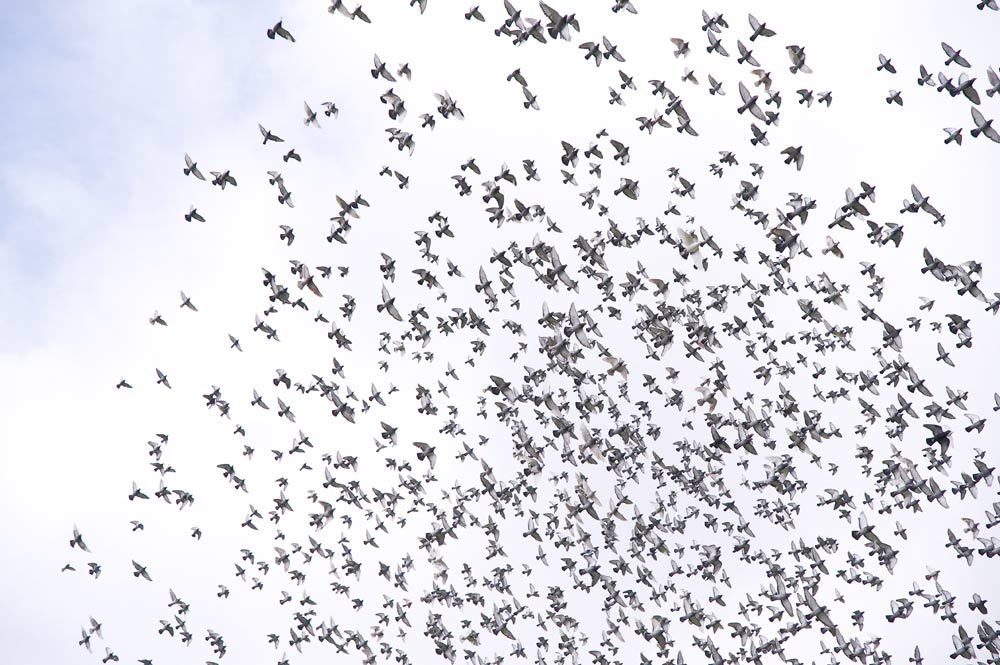
Today I read the article "Birds Flying High?" in the most recent issue of Upfront magazine. This article talks about the latest sports scandal revolving around the "sport" of competitive pigeon racing.  In this sport, pigeons are released hundreds of miles from their homes and electronically tracked to observe how fast they are able to make it home.  This sport has caused much controversy in the last month, as it involves gambling and even some doping.  Overall, I find the entire thing disgusting, and I am amazed that almost nothing has been done to stop it.  For one, it is a clear form of animal abuse, and two, by involving animals in our idea of "recreation," we are bringing out the worst in ourselves.

Pigeon racing, in my shared opinion, is a clear and basic example of animal abuse. In fact, it is the epitome of animal abuse.  The article states "...more than 60% of the birds get lost or die because of bad weather, electrical lines, predators, or exhaustion; and those deemed too slow are often killed." This fact merely showcases the extent to which humans are morally able to go, how, somewhat disgustingly, we are able to push other living creatures' health and lives aside just for a good show.  A good laugh. Apparent fun. Another detail in the article read "One pigeon owner told PETA's investigators that the first thing pigeon racers need to know when starting out in the sport is 'how to kill pigeons.' "


On top of this, Pigeon racing brings out the worst in humans. The article indicates, " In October, the world of pigeon racing was rocked when six birds in Belgium tested postive for banned-performing enhancing drugs ( five for a human painkiller, one for cocaine)." Human baseball players, track runners, swimmers, and bicyclers may inject steroids and other performance- enhancing drugs into their bloodstreams, and this is because they have made the decision to do so. It is an entirely different story when bird holders dope helpless animals just to win. "Pigeon racing has recently become a gambling jackpot, with 15 million in gambling at stake each year in the US." People are in no way gambling with money, they are gambling with the lives of hundreds of pigeons, hundreds of living animals.

But recently, there has been attempts to change it. PETA has recently issued a investigation into the nooks and crannies of this horrific sport, and I guarantee there is much to be exposed.  Hopefully, with these shocking facts out in the open, the public will begin to take action and possibly even impeach it from our society.

Tuesday, December 10, 2013

The Sneetches, by Dr. Seuss

“The grass is always greener on the other side” is one thought that comes to mind after reading the book The Sneetches by Dr. Seuss. This book is a simple yet a perfect example of the complicated issue of discrimination that so many people face today. In our society, people are judged very often based on physical attributes, race, and religion.  In my opinion, this judgement is unkind, untruthful, and most definitely unnecessary. People should not be judged on the basis of unimportant features that in no way make up who they are.

In the children's book, there are two groups of so-called "Sneetches." There are "Star-bellied Sneetches, the best Sneetches on beaches,"and "Plain-bellied Sneetches, left out cold, in the dark of the beaches." The Star-bellied Sneetches are supposedly the "better" Sneetches, but what really, truly makes them that special?  Does a star on your belly determine everything? What about a red dot in the middle of your forehead? Or a six-pointed star hanging from your neck?

Along with his family, Doctor Seuss was a German immigrant.  This makes me think that he interpreted this book to be about discrimination based on religion, as the jews were when the Nazis invaded Europe. He even used stars to symbolize the difference between the greater and the lesser.  In Europe, jews were forced to wear yellow stars on their clothing to signify that they were jewish, and they should be treated accordingly.  Being a jew myself, it is particularly difficult to look back at that time period and learn about the basis of which people were judged and treated.  But doing so has definitely helped me, and maybe even parts of the world, find closure, move on, and help make a better future.

But lets be honest.  People are judged not only by their physical attributes, their race, and their religion.  Everyday, people are judged based on class, gender, smarts, political views, creed, personality, appearance, skin color, ethnicity, language, schooling, residence, and so on.  How can we fix this? Dr. Seuss' answer, along with mine, is cooperation:


"The day they decided that Sneetches are Sneetches
And no kind of Sneetch is the best on the beaches
That day, all the Sneetches forgot about stars
And whether they had one, or not, upon thars."

In order to attain this level of equality, the Sneetches had to cooperate with eachother by accepting eachother's differences.  Now, all Sneetches were Sneetches, the best Sneetches on beaches.


Wednesday, December 4, 2013

Ten Thousand Saints, By Eleanor Henderson


Ten Thousand Saints, by Eleanor Henderson, is a truly moving and inspiring book.  It tells the story of Jude, a teenage boy, trying to find himself amidst a whirlwind of drugs, family issues, pregnancies, and addiction.  He goes from chaotically searching dangerous streets for money to satisfy his addiction, to taking control and becoming "straight edge;" clean, vegan, natural, and focused. Both of these lifestyles lead his personality in wild and unpredictable directions and decisions.  I decided to explore the quirks, advantages, and disadvantages of each.

Jude as a clean, straight edge person seems altogether more focused and driven to achieve his goal; creating and leading a successful band, preaching straight edge values to audiences all across America.  While managing this task, he is able to reconnect with his dysfunctional, drug loving family, and attain closure over his best friend Teddy's death. However, I believe that at my point in the book, straight edge is becoming a bit of an obsession itself.  This makes sense, as Jude seems to needs control in his life after all he's been through.  Straight edge is a time-consuming lifestyle that requires all of Jude's energy and focus, leaving him little time to think about Teddy.  Sometimes, Jude can take it overboard by beating up and threatening druggies on the street, and almost killing a high school senior, Tory Ventura.  At times like these, I want to jump into the story and remind Jude that the straight edge lifestyle is about peace and finding happiness not from substance, not about violence and shoving your ideas in others' faces.

On the other side of the equation is Jude at the beginning of the book: a lonely, wandering boy trying to find his true self among drugs and alcohol, with his best friend at his side. Obviously, drugs were an influence in Jude's life, and I think were a huge factor in his sudden change of heart and way of life.  On drugs, Jude could not think clearly, and often made bad decisions, like huffing the freon that took Teddy's life.  Drugs ruined Jude's chances of a good education, brought his family down, and caused Jude to steal money.  However, Jude on drugs seems to be more kind and warm, and less severe and harsh.  Prudence, his sister states " I liked you when you were on drugs.  You were gentler, sweeter." Overall, being on drugs had many hill-valley like effects on Jude's personality, the people around him, and his world.

In conclusion, Ten Thousand Saints, by Eleanor Henderson is an unforgettable book that teaches many lifelong lessons, one of which I am finally able to absorb. I believe that while Jude was sweeter on drugs, and was more severe straight edge, straight edge is clearly the lifestyle necessary for his personality.  It caused him to be aware of the people around him, and sparked some great ideas.  As the Green Mountain Boys said "Clean is a dream."


Wednesday, November 20, 2013

Choose an article dealing with injustice from a newspaper, magazine, or online news website. Write about why you chose it and what it makes you think about in your own life.

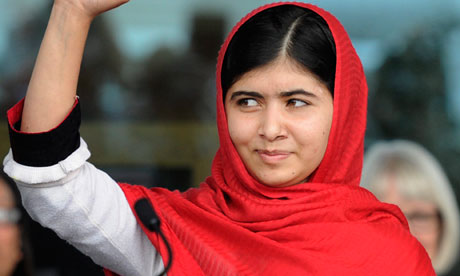
“She was a student fighting to learn, and now she’s fighting to live.”


Malala Yousafzai was a pupil.
Malala Yousafzai was an activist.
Malala Yousafzai was a writer.
Malala Yousafzai was an artist.
Malala Yousafzai was a speaker.
Malala Yousafzai was a girl.
Malala Yousafzai was age 16 when she was shot by Taliban gunmen, returning home from school. Taliban gunmen feared she was sparking a rebellion in Pakistan, a rebellion of women’s rights and education. They may have put a physical hole in her head, but in my mind that only fueled the fire brewing in Asia, the fire that will one day become too big for gunmen to shoot out, too immense to contain. I hope that one day this fire will envelope the whole world.  Then all people will be treated equally, and peace will reign.

Amazingly, girls like Malala all around the world are mistreated, frowned upon, and uneducated.  Many are sold into a life of servitude, or prostitution.  For the millions of girls in situations like these, there is little hope for survival, let alone the future.  Education changes all of this. If you educate a girl, you educate an entire community.  What I mean by this is that educating a girl increases the probability that the girl will find a stable job.  If that girl has children, those children will go to school, grow up, educate the children of their own-and so the cycle continues.

I find it astonishing that human beings are still struggling with the basic right of equality.  In my mind, the root of most social justice issues is equity-the division of rights.  Malala’s story, and many like it make me think about my own life, and the great number of things I take for granted- a meal on the table, new clothes to wear. Consider the high school application process- for example.  So many New Yorkers put an incredible amount of energy into the task of getting accepted into “the best” school, while kids in India and Afghanistan are struggling to attend school at all. 

But there is change coming.  I see it in new headlines, I see it in the tzedakah collector boxes at my temple, I see it in hands clenched tightly together, and I see it in Malala’s incredible recovery.  Girls are being freed all over the world.  They are being 

Sunday, November 10, 2013

Letter to Ms.Berner- Book Banning

“What is perhaps not right for one child is absolutely necessary to another.”
-Ellen Hopkins

Dear Ms Berner,
            An independent reading selection is a sacred and unique choice, one that we students of MS.51 are given daily. This ability to select is in keeping with old-fashioned American ethics like freedom of speech and free pursuit of knowledge. I believe that censorship, or “book banning” as we know it, does very little good for society.  It creates a controversy between kids and adults, and it prevents kids from exploring their world in a safe way.
Many adults are unaware of the books their children are reading. My research has allowed me to form my opinion: it is up to a child and his or her family to select books intriguing and helpful to the child. And it is a school’s job to be open to all types of reading personalities, and supply kids with their guided selections.
Many parents are able to understand how a book could harm their child, but often may not be able to envision a situation in which that book might help another child. This is the type of parental blindness that leads to book banning. In my opinion, books speak to young readers who can relate to the dark issues explored in those titles. In his article, “Why the Best Kids’ Books are Written in Blood,” Sherman Alexie states, “Teens read because they live in an often terrible world. They read because they believe, despite the callow protestations of adults, that books—especially the dark and dangerous ones will save them”. Controversial topics in books often provide models for children in need of help. The article, “Students ask District 41 to reconsider ‘Perks of Being a Wallflower Removal’ ” states, “The book has played its role in helping its readers realize they’re not alone in feeling different.” Challenged books are often the ones most nurturing to teens who need help. By taking away these books, we are invading teen’s lives, and making their conflicts seem insignificant.

Banning books drives a wedge between kids and adults, because it involves the conflict of adults making decisions for their children.  In his article, “Teen Fiction Plots are Darker and Starker,” William Porter earnestly writes, “I think adults shortchange teens and their ability to grasp complex material and make deeper connections.”  When protective adults make decisions about banning books, doesn’t it leave younger readers feeling intellectually violated and disrespected?
I believe overreaction to dark topics in books comes from a place of fear inside caregivers: their children are growing up, and handling more challenging material. “We are willing enough to praise freedom when she is safely tucked away in the past and cannot be a nuisance,” states E.M Forster. “In the present, amidst dangers whose outcome we cannot foresee, we get nervous about her, and admit censorship.”  Adults are comfortable with graphic conflicts in books when their children are not exposed to them.  But once these subjects are easily accessible to teens, the adults jump to extremes, limiting access to books rightfully ours.  Book banning further divides teens and their elders.  In order to come to a solution, we need to find a way to bridge the two groups.
The solution is communication. The issue of censorship cannot be fairly addressed, because of one major flaw: many adults are unaware of the books their kids are reading. In order to make an educated and balanced decision about what our nation’s children should be reading, honest discussion between teachers, parents, and their children is essential. The article “District 41 Slated to Reconsider Ban on ‘Perks of Being a Wallflower’ ” describes the reassessment of the book banning process in District 41. In this reassessment, a new policy was created: at the beginning of the school year, parents would receive a letter asking parents if there were any subjects or books they wanted kept out of their child’s hands. I strongly support this solution to the problem. I think an approach like this would perform wonders at a school like MS 51. “My job is to help children find the books they want to read.  The parent’s job is to help their children decide what books they should read,” claims Jenna Obee, Young Adult specialist at the Stanley Lake Library. This idea, along with District 41’s plan, would allow parents, who know their children the best, to pass judgment on what books their kids should be reading, without affecting the other kids in the classroom.
Some censors disagree strongly with my opinion.  In her article, “Darkness too Visible,” Megan Cox Gurdon states, “No family is obliged to acquiesce when publishers use the vehicle of fundamental-free expression to try to bulldoze misery or coarseness into our children’s lives.”  However, the majority of my research has led me to believe that dark books actually help readers solve their own life issues. Young adult books generally show choices the main character makes, and the negative effects of those choices, causing readers to make better decisions than the main character did. As Sherman Alexie states, “I read books about monsters and monstrous things, often written with monstrous language, because they helped me battle the monsters in my own life.” The censors of America are supposedly “protecting” kids from books, while really all they’re doing is taking away one of the only ways kids across the nation learn how to manage the valleys of their lives.
In conclusion, censorship or book banning does little service to society.  The sixth graders at MS.51 are on the verge of adulthood.  Don’t take away their access to young adult books, just because of more graphic material.  Rather, institute regulations regarding parent-child communication.  This improved solution will nurture all reading personalities, protect kids who need a little less exposure, and let already-exposed kids feel less lonely and left out. As Judy Blume, says, “If parents and kids can talk together, we won't have as much censorship because we won't have as much fear.” Some principals may choose to follow censorship, to choose fear.  But I propose that there is a choice.  And today, I choose bravery.

                                                                                    Sincerely,
                                                                                                Julia Frankel


Sunday, October 20, 2013

"Tweak," By Nic Sheff


Tweak: Growing up on Methamphetamines By Nic Sheff is the autobiographical story of compassionate, intelligent, and loving young man turned crazy and out of control by drugs. This book retells Nic's story of searching for sobriety in a way no one but an addict can. The raw and emotional voice in this story can real a reader in while at the same time make you feel absolutely hopeless and desperate.  It really makes you feel like you are in Nic's shoes, his position.   Amazingly, I was never against Nic as a person, only angry and annoyed at his character.  Throught the story I always found myself routing for the real un-scarred, not drugged Nic. The Nic that we readers can find in every confused and dangerous character in most books on our bookshelf.

Nic's voice in his memoir is incredible, and hard to describe.  What makes this voice unique is that he not only describes his dysfunctional train of thought on drugs, but his self loathing that he feels all the time.  For example, on page 20, Nic states "I was so scared of coming off the drugs.  It was like this horrible vicious cycle.  The more I used, the more I did things I was ashamed of, and the more I had to use so I had to never face that." The blunt stating of these horrible events makes them seem more surreal and harsh.  I think this is because of his straightforward tone and  the way he justifies his actions as normal.

Another aspect of Nic's writing style that makes it stand out is the raw emotion shown. In this book, you in no way needed to look between the lines to find a "hidden meaning," or depth of feeling.  Sheff obviously did not write this book for the emotionally unstable, because he left almost nothing out.  When reading, I had to put the book down for minutes at a time just to think about the gruesomeness of Nic's journey.  For example, "I am so tired.  This painful, aching tired.  I just want to sleep and be left alone-or maybe just die here.  The room is all dark and I'm sweating.  My breathing is strained.  For some reason my shirt is off, my ribs sticking through my skin-tracks up and down both arms..."Honestly, this vivid detail made me skip some parts of the book, scared of what I would read next.

Finally, the last part of Nic's voice that makes it so striking is its ability to put the reader in Nic's shoes.  Although most readers have not been through the ordeal which Nic struggled through, we have all had our own share of conflicts which can relate to Sheff's.  On page 109, Nic struggles with finding himself amidst all his usage: "Honestly, I'm not sure how much longer I can keep doing this. It's like there are seven candles lit in my stomach. One, two, three, four, five, six, seven. Seven candles burning and smoking-lit-seven flames of doubt, fear, sorrow, pain, waste, hopelessness, despair. They turn my insides black with soot and ash. There is something at the back of my eyes-a pressure building, building, building-hot like the flames of seven candles, which no amount of breath can extinguish...The fire eats away my flesh. The fire spreads. The fires runs through my veins. The fire courses beneath muscles-my tendons-the marrow of my bones. I can't keep living like this." These words really tear the reader apart.  I think all human beings can relate to Nic's words in at least one way.  At one point, we have all felt hopeless and depressed.  

 It is a part of our anatomy to rise above and overcome this great burden pulling us down. It is a part of our anatomy to fly, no matter how much weight we have on our wings.  This basic idea of survival is what intrigues readers throughout the book Tweak, by Nic Sheff.  In conclusion, Nic's memoir ends with the words: 

"This feels more like living than everything I've ever known in a long time.  I realize how hard tomorrow is going to be, but for now, I feel so thankful to be where I am.  I feel independent.  I feel like my own person."

Tuesday, October 8, 2013

"Going to War: Who Decides?" By Patricia Smith, Upfront Magazine

The article, "Going to War: Who Decides?" by Patricia Smith discusses the the debate over who has the authority to send American troops into battle in Syria. President Obama made the decision to give congress the responsibility to indicate whether or not we should go to war with Syria.  This surprised many, but it has been an issue in the past.  Who gets control of the army? Did Obama make the right decision?

The question arose when the Syrian government used sarin gas to harm and kill many of it's citizens in a Damascus suburb.  President Obama was put on the spot to lead the nation in what our position should be on the matter.  When President Obama gave up the decision, controversy arose at whether this helped or harmed the nation. The Declaration of war has been a sensitive topic for the US on previous years. As the article states, "Congress has formally declared war only five times... From Washington forward, presidents have engaged in military activities without declarations or authorizations,"This informs the reader that anything to do with "The formal declaration of war," is going to cause an argument, and make people choose sides.

I believe that to other countries, President Obama made the US as a nation seem indecisive and weak.  I think that the power to control the military should be handled by both the executive and legislative branches of government- as the Constitution states, not just the legislative branch. In other words, we need to find a balance of power. I believe this because our country is based off of the morals of freedom and free speech, and we do not want a dictatorship, where war can be declared unilaterally, but our nation does needs a bold leader who can work effectively under pressured conditions.

What other countries may think of as indecisive and weak, I believe is the strength of the US government setup.  As the article states, the framers of the constitution devised a system of checks and balances to keep one branch of government from overpowering the other. So while the president is the Commander in chief of the army and navy, Congress has the power to declare war.  In this way, power is balanced between branches of government. By handing all of his responsibility over to congress, President Obama was not maintaining this balance.  Matthew Spalding states "Presidents are supposed to protect their authority. They naturally want not to defer to congress, especially on national security."

Overall, I think that we as Americans need to find a balance between what the president's job is, and what congress' job is.  If we find that balance, we will be able to make decisions much more efficiently and easily.


Tuesday, October 1, 2013

"Crank" by Ellen Hopkins

"Life was good before I met the monster.
After, life was great.
At least for a little while."

The book that I have recently been reading, Crank, by Ellen Hopkins, is about a young woman, Kristina, who tries methamphetamine and gets addicted.  It is the tale of her struggle with drugs, but also the tale of her relationship with her father and her family.  Evidently, the main issue in this book is drug use and addiction.  But buried beneath that, another issue is identity. This heartbreaking tale demonstrates the damaging and far-reaching effects of using.

One obvious theme in this book is drugs and addiction.  Kristina's life greatly deteriorates when she starts taking methamphetamine, which leads to cocaine and alcohol.  When Kristina first takes meth, she writes:
"Fire!
Your nose ignites.
 Flameless kerosene.
 You want to cry.
Want to scream.
Get the urge to dance.
 You want to let go.
To ride the current.
  Sweeping you away."
These words confused me.  They seemed to advertise the amazing high Kristina felt while on drugs.  But in a few pages, Kristina says
"Two days.  Two nights.
No sleep, no food.
come down off the monster,
you
crash
real
hard."
This is when we realize this book does not romanticize drugs in the least.  It recalls the exact effects of drugs, puts them in a dark light, and most certainly makes the reader ponder meth's far-reaching effects.

Another big issue in this book is family relationships.  Most importantly, Kristina's relationship with her father, who is not a prime influence on Kristina.  In fact, it is his house where Kristina starts doing drugs and snorting meth.
"I mean there I was
snorting crank.
With my dad, boyfriend, and his other girlfriend.
Something majorly wrong with that picture."
 Kristina definately has a conscience.  She knows that what she's doing is damaging, but she cannot help her addicted self.  And with her father, a druggie and an alchoholic, there is no positive influence to wean Kristina off the drugs.

Finally, the more concealed issue in this book is identity. Kristina has a hidden identity- named Bree- that brings out her wild side- that is, snorting crank.
"I summon Bree when dreams no longer satisfy
when gentle clouds of monotony smother thunder
When Kristina cries."
I think Kristina uses Bree as a way to justify her outrageous behavoir while high.
"Bree is no imaginary playmate
No overactive pituary
No alter ego moving in
Hers is the face I wear
treading the riptide
fathomless oceans
where good girls drown."
I interpret this to mean that Bree goes above and beyond actions that "good girls" could only dream of. When reading this book, every time I read the name "Bree," on the page, I associated it with danger.

"Sometimes I want to curl up into a ball and roll away
Sometimes I want to die
I only know one thing that can make me laugh again.
Crank is a way of life
You can turn your back
But you can never really walk away."

In conclusion, the book in verse, "Crank," By Ellen Hopkins show the far-reaching and deteriorating effects of drugs.  This heartbreaking tale made me consider my own choices in life, other's choices, andwhere these decisions take us.  Most importantly, I pondered how they affect us in our future.

Thursday, September 26, 2013

"Faithful Elephants, " by Yukio Tsuchiya

The brief passage, "Faithful Elephants, " tells the true story of animal slaughter at Ueno Zoo in Japan during World War 2 due to orders of the Japanese military.  This text shows the far-reaching effects of war.  In this case, war is effecting both the animals and their trainers at the Ueno Zoo.  By showing us a side of war usually disregarded, "Faithful Elephants," exposes the struggles and hardships we deal with directly in the face of war.

The most obvious toll the war takes in the story is placed upon the elephants, when they are ordered to be killed. In my opinion, Yukio Tsuchiya, the author, utilized the heart breaking story of the elephants starvation as a way to show the monstrosities of war.  For example, "The elephants became thinner and thinner, weaker and weaker... Their small loving eyes began to look like round rubber balls in their drooping, shrunken faces."  These word paint a horrid picture in the readers mind.  Yes, a picture of the elephants, but also the war, the bombs dropping in the background.  Another piece of evidence is shown when the elephants finally meet their end.  "Zookeepers took hold of Tonky and Wanly's bodies, as if to shake them back to life.. Zookeepers raised their fists to the sky and implored 'Stop the war! Stop the war! Stop all wars!' " This is about the point in the story when the author's intentions and opinions become quite clear.  Stop the war.  Stop the war.  Stop all wars.

In "Faithful Elephants," Yukio Tsuchiya shows the far-reaching effects of war not only by telling the story of the elephants, but of their trainers as well.  For example, when the elephants are on the brink of starvation and beg for food, the trainer is so desperate and cares so much for the elephants that he feels the need to ease their pain.  He directly defies orders and brings them their food.  "Eat your food! Please drink.  Drink your water!" War is causing the trainer to do something so against his principles, not to mention his moral being.  When the trainer brings the elephants food, no one, not even the head zookeeper objects.  "Everyone was hoping and praying that if the elephants could survive only one more day, the war might be over and the elephants would be saved."  War was forcing them too, to commit an act so against anything they could have ever imagined.

In conclusion, the true story, "Faithful Elephants," challenges readers to consider the tragic and extensive effects of war.  This text has certainly effected me with its devastating plotline, but it has also inspired me with its hopeful ending.  While war is a horrid thing, the elephant's deaths symbolize the courage and strife of those trying to put an end to the violence.  And with this dedication, this devotion, I believe we will be successful.

Tuesday, September 17, 2013

A Long Walk to Water, by Linda Sue Park- Summer Reading

This summer I read a book titled A Long Walk to Water, by Linda Sue Park. This short novel is about a young boy, Salva, living in Sudan during a war in 1985, and a girl, Nya, also living in Sudan but in 2008.  Salva and Nya's paths intercross in a strange and miraculous way. I loved this book because of the way the author uses simple words to weave a fantastic story. While I can't really relate to this book because my life is so different from Salva's, the author's word made me feel as if I was right there next to Salva as he struggled through the burning desert, and behind Nya as she made her long daily trek to the pond to get water.

The characters of A Long Walk to Water are what really makes the story special. My favorite character in the book was Salva.  I felt that he really was a strong being, and I could really observe his growth from a young scared little boy, to a impulsive adolescent, to a brave man.  Salva's story begins in Sudan in 1985 when his village gets bombed.   Salva manages to escape and joins a group of refugees heading for a camp in Ethiopia.  The conditions of their travel are difficult- there is next to no food or water, and the danger of wild animals is always iminant.  "No one in the group had eaten anything for two days.  Their water was nearly gone. Only the vision of leaving the desert kept them moving through the heat and dust."Salva endures all of this and manages to make it to the camp in Ethiopia.  From there he is sent to the United States to restart his life.  But there is a part of him he knows that will never quite forget his old village and family back in Sudan.

Salva's story is intermingled with that of Nya, a girl living in the same village in Sudan in 2008.  Every day, Nya has to make the long and exhausting journey to the pond (the village water source) to retrieve water for her family.  Slowly the pond water starts getting depleted. The villagers worry what will happen when there is no more water, until one day when two men show up with a plan to make a new well for the villagers.  "Change is coming...I can feel it.  What will become of us, our village?"

Though the character's stories may seem wildly different at first inspection, they are actually quite similar.  They are both about the hardships Salva and Nya had to overcome to get to a better place.  Salva had to make his way across the unforgiving desert, and Nya had to travel great distances to the pond to help her family.  Overall, I think the characters were both able to do this because they had hope of a better future.  This hope is what rewarded them.  Salva managed to start his new life, and Nya's village ended up getting a new well, as well as a school to educate the children.  The author, Linda Sue Park reinforces the similarities of the characters stories by having them cross in the end.  As a reader, I found this part to be truly inspiring.

The book, A Long Walk to Water is a simply written book with a deep and hopeful message; that even in a terrible situation, determined survivors are able to, against all odds, find the future they were dreaming of.