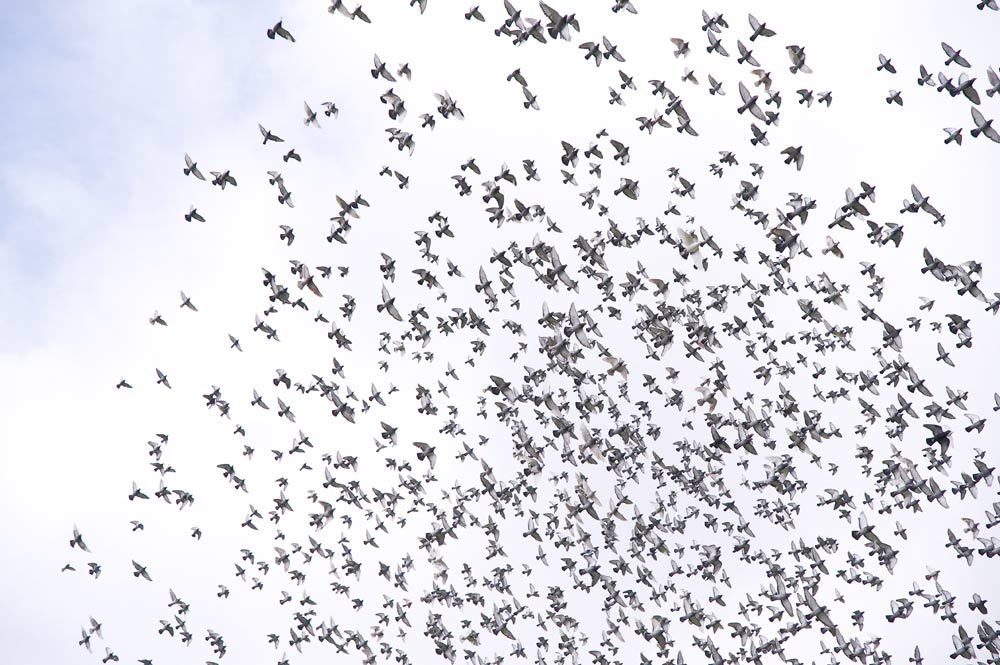
Today I read the article "Birds Flying High?" in the most recent issue of Upfront magazine. This article talks about the latest sports scandal revolving around the "sport" of competitive pigeon racing. In this sport, pigeons are released hundreds of miles from their homes and electronically tracked to observe how fast they are able to make it home. This sport has caused much controversy in the last month, as it involves gambling and even some doping. Overall, I find the entire thing disgusting, and I am amazed that almost nothing has been done to stop it. For one, it is a clear form of animal abuse, and two, by involving animals in our idea of "recreation," we are bringing out the worst in ourselves.
Pigeon racing, in my shared opinion, is a clear and basic example of animal abuse. In fact, it is the epitome of animal abuse. The article states "...more than 60% of the birds get lost or die because of bad weather, electrical lines, predators, or exhaustion; and those deemed too slow are often killed." This fact merely showcases the extent to which humans are morally able to go, how, somewhat disgustingly, we are able to push other living creatures' health and lives aside just for a good show. A good laugh. Apparent fun. Another detail in the article read "One pigeon owner told PETA's investigators that the first thing pigeon racers need to know when starting out in the sport is 'how to kill pigeons.' "
On top of this, Pigeon racing brings out the worst in humans. The article indicates, " In October, the world of pigeon racing was rocked when six birds in Belgium tested postive for banned-performing enhancing drugs ( five for a human painkiller, one for cocaine)." Human baseball players, track runners, swimmers, and bicyclers may inject steroids and other performance- enhancing drugs into their bloodstreams, and this is because they have made the decision to do so. It is an entirely different story when bird holders dope helpless animals just to win. "Pigeon racing has recently become a gambling jackpot, with 15 million in gambling at stake each year in the US." People are in no way gambling with money, they are gambling with the lives of hundreds of pigeons, hundreds of living animals.
But recently, there has been attempts to change it. PETA has recently issued a investigation into the nooks and crannies of this horrific sport, and I guarantee there is much to be exposed. Hopefully, with these shocking facts out in the open, the public will begin to take action and possibly even impeach it from our society.
word noun \ˈwərd\ : a sound or combination of sounds that has a meaning and is spoken or written
Wednesday, December 18, 2013
Tuesday, December 10, 2013
The Sneetches, by Dr. Seuss
“The grass is always greener on the other side” is one thought that comes to mind after reading the book The Sneetches by Dr. Seuss. This book is a simple yet a perfect example of the complicated issue of discrimination that so many people face today. In our society, people are judged very often based on physical attributes, race, and religion. In my opinion, this judgement is unkind, untruthful, and most definitely unnecessary. People should not be judged on the basis of unimportant features that in no way make up who they are.
In the children's book, there are two groups of so-called "Sneetches." There are "Star-bellied Sneetches, the best Sneetches on beaches,"and "Plain-bellied Sneetches, left out cold, in the dark of the beaches." The Star-bellied Sneetches are supposedly the "better" Sneetches, but what really, truly makes them that special? Does a star on your belly determine everything? What about a red dot in the middle of your forehead? Or a six-pointed star hanging from your neck?
Along with his family, Doctor Seuss was a German immigrant. This makes me think that he interpreted this book to be about discrimination based on religion, as the jews were when the Nazis invaded Europe. He even used stars to symbolize the difference between the greater and the lesser. In Europe, jews were forced to wear yellow stars on their clothing to signify that they were jewish, and they should be treated accordingly. Being a jew myself, it is particularly difficult to look back at that time period and learn about the basis of which people were judged and treated. But doing so has definitely helped me, and maybe even parts of the world, find closure, move on, and help make a better future.
But lets be honest. People are judged not only by their physical attributes, their race, and their religion. Everyday, people are judged based on class, gender, smarts, political views, creed, personality, appearance, skin color, ethnicity, language, schooling, residence, and so on. How can we fix this? Dr. Seuss' answer, along with mine, is cooperation:
In the children's book, there are two groups of so-called "Sneetches." There are "Star-bellied Sneetches, the best Sneetches on beaches,"and "Plain-bellied Sneetches, left out cold, in the dark of the beaches." The Star-bellied Sneetches are supposedly the "better" Sneetches, but what really, truly makes them that special? Does a star on your belly determine everything? What about a red dot in the middle of your forehead? Or a six-pointed star hanging from your neck?
Along with his family, Doctor Seuss was a German immigrant. This makes me think that he interpreted this book to be about discrimination based on religion, as the jews were when the Nazis invaded Europe. He even used stars to symbolize the difference between the greater and the lesser. In Europe, jews were forced to wear yellow stars on their clothing to signify that they were jewish, and they should be treated accordingly. Being a jew myself, it is particularly difficult to look back at that time period and learn about the basis of which people were judged and treated. But doing so has definitely helped me, and maybe even parts of the world, find closure, move on, and help make a better future.
But lets be honest. People are judged not only by their physical attributes, their race, and their religion. Everyday, people are judged based on class, gender, smarts, political views, creed, personality, appearance, skin color, ethnicity, language, schooling, residence, and so on. How can we fix this? Dr. Seuss' answer, along with mine, is cooperation:
"The day they decided that Sneetches are Sneetches
And no kind of Sneetch is the best on the beaches
That day, all the Sneetches forgot about stars
And whether they had one, or not, upon thars."
In order to attain this level of equality, the Sneetches had to cooperate with eachother by accepting eachother's differences. Now, all Sneetches were Sneetches, the best Sneetches on beaches.
Wednesday, December 4, 2013
Ten Thousand Saints, By Eleanor Henderson
Ten Thousand Saints, by Eleanor Henderson, is a truly moving and inspiring book. It tells the story of Jude, a teenage boy, trying to find himself amidst a whirlwind of drugs, family issues, pregnancies, and addiction. He goes from chaotically searching dangerous streets for money to satisfy his addiction, to taking control and becoming "straight edge;" clean, vegan, natural, and focused. Both of these lifestyles lead his personality in wild and unpredictable directions and decisions. I decided to explore the quirks, advantages, and disadvantages of each.
Jude as a clean, straight edge person seems altogether more focused and driven to achieve his goal; creating and leading a successful band, preaching straight edge values to audiences all across America. While managing this task, he is able to reconnect with his dysfunctional, drug loving family, and attain closure over his best friend Teddy's death. However, I believe that at my point in the book, straight edge is becoming a bit of an obsession itself. This makes sense, as Jude seems to needs control in his life after all he's been through. Straight edge is a time-consuming lifestyle that requires all of Jude's energy and focus, leaving him little time to think about Teddy. Sometimes, Jude can take it overboard by beating up and threatening druggies on the street, and almost killing a high school senior, Tory Ventura. At times like these, I want to jump into the story and remind Jude that the straight edge lifestyle is about peace and finding happiness not from substance, not about violence and shoving your ideas in others' faces.
On the other side of the equation is Jude at the beginning of the book: a lonely, wandering boy trying to find his true self among drugs and alcohol, with his best friend at his side. Obviously, drugs were an influence in Jude's life, and I think were a huge factor in his sudden change of heart and way of life. On drugs, Jude could not think clearly, and often made bad decisions, like huffing the freon that took Teddy's life. Drugs ruined Jude's chances of a good education, brought his family down, and caused Jude to steal money. However, Jude on drugs seems to be more kind and warm, and less severe and harsh. Prudence, his sister states " I liked you when you were on drugs. You were gentler, sweeter." Overall, being on drugs had many hill-valley like effects on Jude's personality, the people around him, and his world.
In conclusion, Ten Thousand Saints, by Eleanor Henderson is an unforgettable book that teaches many lifelong lessons, one of which I am finally able to absorb. I believe that while Jude was sweeter on drugs, and was more severe straight edge, straight edge is clearly the lifestyle necessary for his personality. It caused him to be aware of the people around him, and sparked some great ideas. As the Green Mountain Boys said "Clean is a dream."
Wednesday, November 20, 2013
Choose an article dealing with injustice from a newspaper, magazine, or online news website. Write about why you chose it and what it makes you think about in your own life.
“She
was a student fighting to learn, and now she’s fighting to live.”
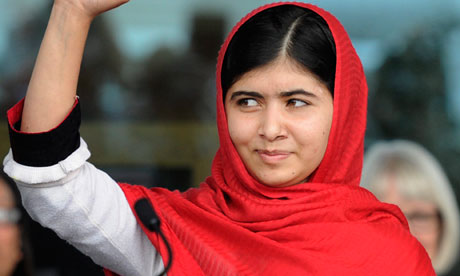
Malala Yousafzai was a pupil.
Malala Yousafzai was an activist.
Malala Yousafzai was a writer.
Malala Yousafzai was an artist.
Malala Yousafzai was a speaker.
Malala Yousafzai was a girl.
Malala
Yousafzai was age 16 when she was shot by Taliban gunmen, returning home from
school. Taliban gunmen feared she was sparking a rebellion in Pakistan, a
rebellion of women’s rights and education. They may have put a physical hole in
her head, but in my mind that only fueled the fire brewing in Asia, the fire
that will one day become too big for gunmen to shoot out, too immense to
contain. I hope that one day this fire will envelope the whole world. Then all people will be treated
equally, and peace will reign.
Amazingly,
girls like Malala all around the world are mistreated, frowned upon, and
uneducated. Many are sold into a
life of servitude, or prostitution.
For the millions of girls in situations like these, there is little hope
for survival, let alone the future.
Education changes all of this. If you educate a girl, you educate an
entire community. What I mean by
this is that educating a girl increases the probability that the girl will find
a stable job. If that girl has
children, those children will go to school, grow up, educate the children of
their own-and so the cycle continues.
I
find it astonishing that human beings are still struggling with the basic right
of equality. In my mind, the root
of most social justice issues is equity-the division of rights. Malala’s story, and many like it make
me think about my own life, and the great number of things I take for granted-
a meal on the table, new clothes to wear. Consider the high school application process-
for example. So many New Yorkers
put an incredible amount of energy into the task of getting accepted into “the
best” school, while kids in India and Afghanistan are struggling to attend
school at all.
Sunday, November 10, 2013
Letter to Ms.Berner- Book Banning
“What is perhaps not right for one
child is absolutely necessary to another.”
-Ellen Hopkins
Dear Ms Berner,
An
independent reading selection is a sacred and unique choice, one that we
students of MS.51 are given daily. This ability to select is in keeping with old-fashioned
American ethics like freedom of speech and free pursuit of knowledge. I believe
that censorship, or “book banning” as we know it, does very little good for
society. It creates a controversy
between kids and adults, and it prevents kids from exploring their world in a
safe way.
Many adults are
unaware of the books their children are reading. My research has allowed me to
form my opinion: it is up to a child and his or her family to select books
intriguing and helpful to the child. And it is a school’s job to be open to all
types of reading personalities, and supply kids with their guided selections.
Many parents are
able to understand how a book could harm their child, but often may not be able
to envision a situation in which that book might help another child. This is
the type of parental blindness that leads to book banning. In my opinion, books
speak to young readers who can relate to the dark issues explored in those
titles. In his article, “Why the Best Kids’ Books are Written in Blood,”
Sherman Alexie states, “Teens read because they live in an often terrible
world. They read because they believe, despite the callow protestations of
adults, that books—especially the dark and dangerous ones will save them”. Controversial
topics in books often provide models for children in need of help. The article,
“Students ask District 41 to reconsider ‘Perks of Being a Wallflower Removal’ ”
states, “The book has played its role in helping its readers realize they’re
not alone in feeling different.” Challenged books are often the ones most nurturing
to teens who need help. By taking away these books, we are invading teen’s
lives, and making their conflicts seem insignificant.
Banning books drives
a wedge between kids and adults, because it involves the conflict of adults
making decisions for their children.
In his article, “Teen Fiction Plots are Darker and Starker,” William
Porter earnestly writes, “I think adults shortchange teens and their ability to
grasp complex material and make deeper connections.” When protective adults make decisions about banning books,
doesn’t it leave younger readers feeling intellectually violated and
disrespected?
I believe
overreaction to dark topics in books comes from a place of fear inside
caregivers: their children are growing up, and handling more challenging
material. “We are willing enough to praise freedom when she is safely tucked away
in the past and cannot be a nuisance,” states E.M Forster. “In the present, amidst
dangers whose outcome we cannot foresee, we get nervous about her, and admit
censorship.” Adults are comfortable with
graphic conflicts in books when their children are not exposed to them. But once these subjects are easily
accessible to teens, the adults jump to extremes, limiting access to books
rightfully ours. Book banning
further divides teens and their elders. In order to come to a solution,
we need to find a way to bridge the two groups.
The solution is
communication. The issue of censorship cannot be fairly addressed, because of
one major flaw: many adults are unaware of the books their kids are reading. In
order to make an educated and balanced decision about what our nation’s
children should be reading, honest discussion between teachers, parents, and
their children is essential. The article “District 41 Slated to Reconsider Ban
on ‘Perks of Being a Wallflower’ ” describes the reassessment of the book
banning process in District 41. In this reassessment, a new policy was created:
at the beginning of the school year, parents would receive a letter asking
parents if there were any subjects or books they wanted kept out of their
child’s hands. I strongly support this solution to the problem. I think an
approach like this would perform wonders at a school like MS 51. “My job is to
help children find the books they want to read. The parent’s job is to help their children decide what books
they should read,” claims Jenna Obee, Young Adult specialist at the Stanley
Lake Library. This idea, along with District 41’s plan, would allow parents,
who know their children the best, to pass judgment on what books their kids
should be reading, without affecting the other kids in the classroom.
Some
censors disagree strongly with my opinion. In her article, “Darkness too
Visible,” Megan Cox Gurdon states, “No family is obliged to acquiesce when
publishers use the vehicle of fundamental-free expression to try to bulldoze
misery or coarseness into our children’s lives.” However, the majority of
my research has led me to believe that dark books actually help readers solve
their own life issues. Young adult books generally show choices the main
character makes, and the negative effects of those choices, causing readers to
make better decisions than the main character did. As Sherman Alexie states, “I
read books about monsters and monstrous things, often written with monstrous
language, because they helped me battle the monsters in my own life.” The
censors of America are supposedly “protecting” kids from books, while really
all they’re doing is taking away one of the only ways kids across the nation learn
how to manage the valleys of their lives.
In
conclusion, censorship or book banning does little service to society. The sixth graders at MS.51 are on the
verge of adulthood. Don’t take
away their access to young adult books, just because of more graphic
material. Rather, institute
regulations regarding parent-child communication. This improved solution will nurture all reading personalities,
protect kids who need a little less exposure, and let already-exposed kids feel
less lonely and left out. As Judy Blume, says, “If parents and kids can talk together,
we won't have as much censorship because we won't have as much fear.” Some principals may choose to follow censorship, to
choose fear. But I propose that
there is a choice. And today, I
choose bravery.
Sincerely,
Julia
Frankel
Sunday, October 20, 2013
"Tweak," By Nic Sheff
Tweak: Growing up on Methamphetamines By Nic Sheff is the autobiographical story of compassionate, intelligent, and loving young man turned crazy and out of control by drugs. This book retells Nic's story of searching for sobriety in a way no one but an addict can. The raw and emotional voice in this story can real a reader in while at the same time make you feel absolutely hopeless and desperate. It really makes you feel like you are in Nic's shoes, his position. Amazingly, I was never against Nic as a person, only angry and annoyed at his character. Throught the story I always found myself routing for the real un-scarred, not drugged Nic. The Nic that we readers can find in every confused and dangerous character in most books on our bookshelf.
Nic's voice in his memoir is incredible, and hard to describe. What makes this voice unique is that he not only describes his dysfunctional train of thought on drugs, but his self loathing that he feels all the time. For example, on page 20, Nic states "I was so scared of coming off the drugs. It was like this horrible vicious cycle. The more I used, the more I did things I was ashamed of, and the more I had to use so I had to never face that." The blunt stating of these horrible events makes them seem more surreal and harsh. I think this is because of his straightforward tone and the way he justifies his actions as normal.
Another aspect of Nic's writing style that makes it stand out is the raw emotion shown. In this book, you in no way needed to look between the lines to find a "hidden meaning," or depth of feeling. Sheff obviously did not write this book for the emotionally unstable, because he left almost nothing out. When reading, I had to put the book down for minutes at a time just to think about the gruesomeness of Nic's journey. For example, "I am so tired. This painful, aching tired. I just want to sleep and be left alone-or maybe just die here. The room is all dark and I'm sweating. My breathing is strained. For some reason my shirt is off, my ribs sticking through my skin-tracks up and down both arms..."Honestly, this vivid detail made me skip some parts of the book, scared of what I would read next.
Finally, the last part of Nic's voice that makes it so striking is its ability to put the reader in Nic's shoes. Although most readers have not been through the ordeal which Nic struggled through, we have all had our own share of conflicts which can relate to Sheff's. On page 109, Nic struggles with finding himself amidst all his usage: "Honestly, I'm not sure how much longer I can keep doing this. It's like there are seven candles lit in my stomach. One, two, three, four, five, six, seven. Seven candles burning and smoking-lit-seven flames of doubt, fear, sorrow, pain, waste, hopelessness, despair. They turn my insides black with soot and ash. There is something at the back of my eyes-a pressure building, building, building-hot like the flames of seven candles, which no amount of breath can extinguish...The fire eats away my flesh. The fire spreads. The fires runs through my veins. The fire courses beneath muscles-my tendons-the marrow of my bones. I can't keep living like this." These words really tear the reader apart. I think all human beings can relate to Nic's words in at least one way. At one point, we have all felt hopeless and depressed.
It is a part of our anatomy to rise above and overcome this great burden pulling us down. It is a part of our anatomy to fly, no matter how much weight we have on our wings. This basic idea of survival is what intrigues readers throughout the book Tweak, by Nic Sheff. In conclusion, Nic's memoir ends with the words:
"This feels more like living than everything I've ever known in a long time. I realize how hard tomorrow is going to be, but for now, I feel so thankful to be where I am. I feel independent. I feel like my own person."
Tuesday, October 8, 2013
"Going to War: Who Decides?" By Patricia Smith, Upfront Magazine
The article, "Going to War: Who Decides?" by Patricia Smith discusses the the debate over who has the authority to send American troops into battle in Syria. President Obama made the decision to give congress the responsibility to indicate whether or not we should go to war with Syria. This surprised many, but it has been an issue in the past. Who gets control of the army? Did Obama make the right decision?
The question arose when the Syrian government used sarin gas to harm and kill many of it's citizens in a Damascus suburb. President Obama was put on the spot to lead the nation in what our position should be on the matter. When President Obama gave up the decision, controversy arose at whether this helped or harmed the nation. The Declaration of war has been a sensitive topic for the US on previous years. As the article states, "Congress has formally declared war only five times... From Washington forward, presidents have engaged in military activities without declarations or authorizations,"This informs the reader that anything to do with "The formal declaration of war," is going to cause an argument, and make people choose sides.
I believe that to other countries, President Obama made the US as a nation seem indecisive and weak. I think that the power to control the military should be handled by both the executive and legislative branches of government- as the Constitution states, not just the legislative branch. In other words, we need to find a balance of power. I believe this because our country is based off of the morals of freedom and free speech, and we do not want a dictatorship, where war can be declared unilaterally, but our nation does needs a bold leader who can work effectively under pressured conditions.
What other countries may think of as indecisive and weak, I believe is the strength of the US government setup. As the article states, the framers of the constitution devised a system of checks and balances to keep one branch of government from overpowering the other. So while the president is the Commander in chief of the army and navy, Congress has the power to declare war. In this way, power is balanced between branches of government. By handing all of his responsibility over to congress, President Obama was not maintaining this balance. Matthew Spalding states "Presidents are supposed to protect their authority. They naturally want not to defer to congress, especially on national security."
Overall, I think that we as Americans need to find a balance between what the president's job is, and what congress' job is. If we find that balance, we will be able to make decisions much more efficiently and easily.
The question arose when the Syrian government used sarin gas to harm and kill many of it's citizens in a Damascus suburb. President Obama was put on the spot to lead the nation in what our position should be on the matter. When President Obama gave up the decision, controversy arose at whether this helped or harmed the nation. The Declaration of war has been a sensitive topic for the US on previous years. As the article states, "Congress has formally declared war only five times... From Washington forward, presidents have engaged in military activities without declarations or authorizations,"This informs the reader that anything to do with "The formal declaration of war," is going to cause an argument, and make people choose sides.
I believe that to other countries, President Obama made the US as a nation seem indecisive and weak. I think that the power to control the military should be handled by both the executive and legislative branches of government- as the Constitution states, not just the legislative branch. In other words, we need to find a balance of power. I believe this because our country is based off of the morals of freedom and free speech, and we do not want a dictatorship, where war can be declared unilaterally, but our nation does needs a bold leader who can work effectively under pressured conditions.
What other countries may think of as indecisive and weak, I believe is the strength of the US government setup. As the article states, the framers of the constitution devised a system of checks and balances to keep one branch of government from overpowering the other. So while the president is the Commander in chief of the army and navy, Congress has the power to declare war. In this way, power is balanced between branches of government. By handing all of his responsibility over to congress, President Obama was not maintaining this balance. Matthew Spalding states "Presidents are supposed to protect their authority. They naturally want not to defer to congress, especially on national security."
Overall, I think that we as Americans need to find a balance between what the president's job is, and what congress' job is. If we find that balance, we will be able to make decisions much more efficiently and easily.
Subscribe to:
Posts (Atom)